Understanding
ACEs & Toxic Stress
Explore the research behind Adverse Childhood Experiences (ACEs), the biology of toxic stress, and the evidence-based strategies that reduce risk and improve outcomes.
THE LANDMARK STUDY
Adverse Childhood Experiences, or ACEs, refers to a set of 10 categories of common experiences occurring in the first 18 years of life originally researched
in the landmark study conducted by CDC and Kaiser.

THE PROBLEM
The science is clear: early adversity affects health across a lifetime. Yet for most children and families, help is coming too late. It is time to transform our systems to reflect the science.
Adverse Childhood Experiences (ACEs) and toxic stress are a shared challenge across communities, zip codes, income, race, gender, and political affiliation.
17%
Of adults in the United States have experienced four or more ACEs

64%
Of adults in the United States have experienced at least one ACE

ACEs – like abuse, neglect, or growing up in a household with substance dependence or mental health challenges – are associated with increased risk of more than 40 health conditions, including nine of the 10 leading causes of death in the U.S.
The consequences are not just for the individual. They ripple outward – affecting entire families, communities, and our society as a whole, with an estimated 28.4% of current Medicaid expenditures attributable as excess expenditures due to ACEs.[1]
Children with ACEs are substantially more likely to have socioeconomic disadvantages as young adults. Evidence on the long-term socioeconomic burden of childhood adversity is essential to increase understanding of the value of investments in prevention strategies.
ACEs and Social Risk
1 ACE
2-3 ACEs
4 + ACEs
Any ACEs
Probability changes in socioeconomic disadvantages associated with cumulative adverse childhood experiences (ACEs) for people in 4 states who were ages 18-22 during 2017-21.

FREQUENTLY ASKED QUESTIONS
Here are answers to some of your most
frequently asked questions:
01 What are adverse childhood experiences (ACEs)?
The term adverse childhood experiences is often used to refer to a variety of adversities in childhood, but when capitalized, Adverse Childhood Experiences (ACEs) specifically reference the 10 categories of adversities investigated in the landmark research study of the same name. The ACE Study was conducted by the Centers for Disease Control and Prevention (CDC) and Kaiser Permanente among a clinical population of 17,337 middle-class adults and investigated a set of 10 categories of common experiences occurring in the first 18 years of life. The findings, first published in 1998, revealed that ACEs are highly prevalent and demonstrate a strong dose-response relationship with numerous negative health and social consequences in adulthood.
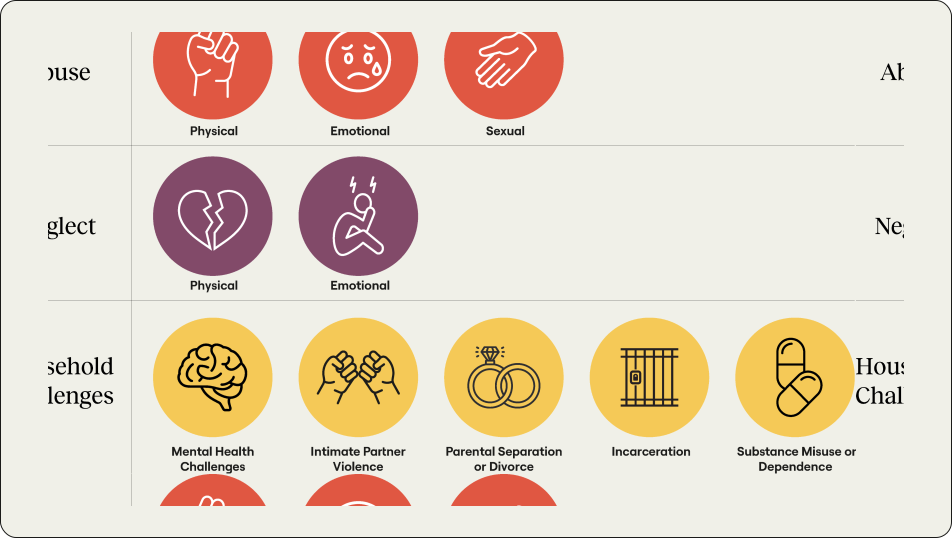
Figure 1: The 10 ACE categories investigated in the landmark study by the CDC and Kaiser Permanente.
02 What is the association between ACEs and health and well-being?
ACEs are highly prevalent. More than 64% of adults in the United States have experienced at least one ACE and more than 1 in 6 (17%) have experienced four or more.
The Centers for Disease Control and Prevention recently published the first nationally representative, self-reported estimates of ACEs among U.S. high school students. The study found that more than three in four students (76.1%) had experienced at least one ACE, and nearly one in five students (18.5%) had experienced 4 four or more.
03 How common are adverse childhood experiences (ACEs)?
ACEs are strongly associated, in a dose-response fashion, with some of the most common and serious health and social conditions facing our society, including nine of the 10 leading causes of death in the United States (Table 1). Extensive research demonstrates that:
- There is a dose-response relationship between ACEs and over 40 common and serious health and social conditions.
- The life expectancy of individuals with six or more ACEs is nearly 20 years shorter than that of individuals with none.
- The ACEs Aware Initiative highlights a broad, though not exhaustive, set of pediatric and health conditions associated with ACEs.
| Leading Causes of Death in the U.S., 2023 |
Odds Ratio for > 4 ACEs (relative to no ACEs) |
| Heart disease | 2.1 |
| Cancer | 2.3 |
| Unintentional injuries (injury with fracture) | 2.6 |
| Stroke | 2.0 |
| Chronic lower respiratory diseases | 3.1 |
| Alzheimer’s disease (memory impairment) | 4.9 |
| Diabetes | 1.4 |
| Kidney disease | 1.7 |
| Chronic liver disease and cirrhosis (hepatitis or jaundice) |
2.4 |
| COVID-19 | Unknown |
04 What is toxic stress?
High doses of cumulative adversity experienced during critical and sensitive periods of development, without adequate buffering protections can become biologically embedded. The subsequent biological changes are known as the toxic stress response, which refers to “prolonged activation of the stress response systems that can disrupt the development of brain architecture and other organ systems, and increase the risk for stress-related disease and cognitive impairment, well into the adult years.” The toxic stress response does not refer to a single stressful event or acute stressor, but rather to the chronic dysregulation of the body’s stress response systems.
05 What is the intergenerational transmission of ACEs and toxic stress?
Intergenerational transmission of ACEs and toxic stress physiology occurs when adverse experiences alter parental biology or behavior in ways that affect the development and health of their children.
Intergenerational transmission of toxic stress physiology includes changes to parental and child neuro-endocrine-immune-metabolic and genetic/genetic regulatory function, in ways that matter for pre-conception health, and also influence pregnancy, birth, infant, and child health outcomes. Parenting behaviors, positive experiences, societal factors, and historical traumas also influence the way that health risks are passed on from parent to child.
06 Are ACEs the only risk factors for toxic stress physiology?
ACEs are well-established risk factors for toxic stress physiology, but they are not the only ones. While the strongest and most standardized evidence exists for the original 10 ACE categories, the field has evolved to recognize that other forms of adversity, such as experiencing racism or discrimination, community violence, and poverty, can also activate the body’s stress response systems in similar ways. These adversities affect health and well-being through multiple pathways, including their impact on the stress response system. However, the evidence base describing their precise biological mechanisms and long-term health effects across the life course is less standardized than that for the original 10 ACEs. For this reason, we refer to them as additional risk factors for toxic stress, acknowledging their importance while maintaining a clear distinction from the original 10 ACEs, for which the epidemiological and mechanistic evidence is most robust.
07 Do all individuals who experience ACEs develop toxic stress physiology?
Not everyone with ACEs will develop toxic stress physiology. The interaction between our environment, how we experience stressors, the strategies we used to manage and mitigate stress, and our underlying and inherited biology all play a role in whether a person ultimately develops toxic stress physiology.
The presence of protective factors, like safe, stable, nurturing relationships, environments, and interventions, timing of risk and protective factors, and individual differences in biological susceptibility, can alter risk for toxic stress physiology and related health and social sequelae.
Protective factors are intrinsic or extrinsic factors that buffer against childhood adversity and play a critical role in preventing and mitigating toxic stress physiology. Protective factors can reduce the risk that exposure to ACEs will trigger toxic stress physiology, and can lessen the negative impacts when adversity has already occurred. It is important to recognize, however, that the evidence base for protective factors is not as standardized as it is for the original 10 ACEs.